
Quick answer
A refrigerated workbench puts cold storage directly under the work surface, so the food you are prepping is never more than an arm’s length from the cold. An upright fridge holds more volume per square metre of floor but forces a walk for every item. Choose the workbench when the prep station is the constraint; choose the upright when bulk storage and stock rotation are.
What is the real difference between the two?
Both hold food at the same temperature. The difference is where the storage sits relative to the operator’s hands.
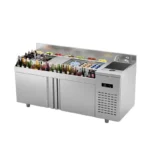
A refrigerated workbench is a work table with a refrigerated base — doors, drawers, or a combination — and usually a small raised rail at the back for frequently used ingredients. It collapses two functions into one footprint: the surface you cut on and the cold you draw from. Its storage volume is modest, its access time is short, and the operator never leaves the station.
An upright fridge is a vertical cabinet, one or two doors, shelving on several levels. It holds far more per unit of floor area because it stacks volume vertically rather than horizontally. Access requires walking to the cabinet, opening a door, finding the item and returning — which in a busy service is where the time goes.
A third option, often overlooked, is the under-counter drawer unit with no work surface above it. It suits a station that already has a table, and it makes better use of depth than a door-based base because drawers pull out and present their contents rather than hiding them behind a door.
The layout decision is really a question about how often each item is touched. Ingredients touched every few minutes belong within arm’s reach. Ingredients touched a few times per service belong in a cabinet, in date order, where a walk is acceptable.
Which one keeps food colder during service?
Temperature is not only about the thermostat setting; it is about recovery after each opening, and the two formats are opened very differently.
The regulated requirement is the same for both. Under the FDA Food Code, section 3-501.16, time/temperature control for safety food must be held at 5 °C (41 °F) or less except during preparation, cooking or cooling. Section 4-301.11 adds the qualitative requirement that equipment for holding cold food must be sufficient in number and capacity to provide those temperatures — which is a capacity test, not a thermostat test.
A workbench is opened many times per hour, for seconds at a time, and its evaporator is close to the food. That pattern favours fast, shallow openings, provided the base is not overfilled and the air path is not blocked by a deep gastronorm pan sitting proud of the rail line.
An upright is opened less often but for longer, because the operator is searching. The damage is done by open-door time and by the warm air that enters at the top of the cabinet and falls through the shelves. A well-organised upright with labelled shelves and a door that closes itself outperforms a disorganised one of the same model by a wide margin.
What actually decides whether either format holds 5 °C is the loading discipline. A base packed to the door with warm product after prep will not recover before service, and no cabinet specification fixes that.
How do you size cold capacity from the menu?
Start from the prep list, not from the equipment catalogue.
List every item that is held cold at the station. For each, note the container size, how many containers are in use at peak, and whether it is replenished from a walk-in during service or held for the whole shift. That gives a working volume, and the working volume — not the nominal capacity — is what the cabinet has to accommodate with air still able to move around the pans.
Three rules make the arithmetic realistic:
- Count the pan, not the litre. A base rated at a nominal volume holds fewer gastronorm pans than the division suggests once the pan depth and the rail height are taken into account.
- Reserve space for airflow. A base filled to the door stops behaving like a refrigerator and starts behaving like an insulated box with food in it.
- Plan for the second container. The item in use sits on the rail; the backup sits in the base. Sizing for one container per item is the most common under-specification in a new kitchen.
Then allocate. Bulk stock, backup containers and items used once or twice per service go to the upright or the walk-in. The workbench carries only what the station touches continuously. A kitchen that tries to make the workbench the primary store ends up with a base that is opened constantly, is never closed properly, and cannot hold temperature.
When does a workbench replace an upright, and when does it not?
| Situation | Better choice | Why |
|---|---|---|
| High-volume prep line, one cook per station | Refrigerated workbench | Eliminates the walk; keeps ingredients within reach |
| Small kitchen with limited floor area | Workbench or under-counter drawers | Two functions in one footprint |
| Menu with many low-volume garnishes | Upright with labelled shelves | Breadth of items, low access frequency |
| Central kitchen batching large volumes | Upright plus walk-in | Volume, not access speed, is the constraint |
| Bar or front-of-house prep | Under-counter drawers | Presents contents, fits below a counter |
| Pastry and dessert plating | Workbench with rail, plus a low-temperature cabinet | Frequent access plus stable temperature for finished items |
The rule behind the table: a workbench earns its cost when the time saved per service outweighs the storage volume lost. In a station where a cook walks to a fridge forty times a shift, the walk is the cost. In a store room where stock is touched twice a day, the walk is irrelevant and the volume matters more.
There is a hybrid worth considering: a workbench in the prep area for the line, and an upright immediately behind it for backup. That pairing usually beats either format used alone, and it costs less floor area than two workbenches.
What does each cost to run and to keep clean?
Running cost follows the same logic as any commercial refrigerator: the regulated class, the door type and the way it is used. In the United States, refrigerated cabinets fall under the commercial refrigeration equipment standards in 10 CFR 431.66, where the maximum daily energy consumption depends on the equipment class — horizontal closed, vertical closed, solid or transparent door — and on volume or display area. A workbench and an upright are therefore not one category with one number; the class designation on the specification sheet is what makes the figures comparable.
Cleaning is where the formats differ most in practice. A workbench base has a low, deep interior that is awkward to reach; drawers come out, which makes them easier to clean but adds a gasket and a slide to maintain on each drawer. An upright has shelves that lift out and a floor that is easy to wipe, but more surface area overall. Whichever you choose, the specification should confirm that the interior corners are coved and that the base can be cleaned without tools.
Condensers need the same attention in both formats: a coil that is never cleaned raises condensing temperature and pushes consumption above the rated figure regardless of class.
What should the specification sheet state?
Six items separate a usable quotation from a comparable one.
| Item | What to look for |
|---|---|
| Temperature class and rated ambient | Holding temperature and the ambient it was rated at — a cabinet rated at 32 °C behaves differently at 40 °C |
| Equipment class designation | Determines the applicable efficiency limit and makes vendor figures comparable |
| Refrigerant and charge | Compliance and future service options |
| Interior configuration | Pan sizes accepted, drawer or door, rail height, coved corners |
| Defrost method | Automatic, off-cycle or demand; affects temperature stability |
| Gasket and hardware part numbers | Whether the seal and the slides can be replaced locally |
Add the electrical configuration and the plug type for the destination market, and confirm whether the unit is supplied with castors, legs or a plinth — the working height changes with each, and working height is the reason to buy a workbench in the first place.
Where Zhongji Metal fits
Zhongji Metal has manufactured stainless steel commercial kitchen and refrigeration equipment in Shandong, China since 2010 and exports to more than 130 countries. The refrigerated workbench is built with a stainless work surface, coved interior corners and a choice of door or drawer configuration, with the temperature class, refrigerant and pan capacity stated on the specification sheet. For stations that need storage only, the stainless steel workbench pairs with an upright cabinet; for compact footprints, the one-door mini bar fridge covers low-volume holding.
Workbenches are quoted with the surface gauge and the base configuration together, because a heavy-gauge top on a light base is a specification error that only shows up after installation. The full refrigeration and stainless range is listed on our Alibaba.com storefront; CE marking is available for EU-bound orders and final electrical configuration is confirmed per order.
Frequently asked questions
Is a refrigerated workbench more expensive than an upright fridge?
Per unit of storage volume, usually yes, because you are paying for a stainless work surface and a shallow refrigerated base rather than a tall cabinet. Per station, it can be cheaper than a table plus a separate cabinet in a small kitchen, since it occupies one footprint instead of two. Compare the total station cost, not the unit price.
Can a refrigerated workbench replace a walk-in cooler?
No. A workbench base is a working store for items in active use, not a bulk store. It has limited volume, opens constantly and cannot hold stock at stable temperature through a full service. Use it for the line, and keep bulk and backup stock in a walk-in or a dedicated cabinet.
What temperature should a refrigerated prep table hold?
The same requirement as any cold-holding equipment: 5 °C (41 °F) or less for time/temperature control for safety food under FDA Food Code section 3-501.16. The practical test is the product temperature at the end of service, not the display reading, because frequent opening is what moves the food temperature.
Do drawers or doors keep food colder?
Drawers limit the volume of air exchanged per opening, which helps recovery, but each drawer adds a gasket and a slide to maintain. Doors are simpler and cheaper to service. Choose drawers where access speed matters most, doors where maintenance access is limited.
How much clearance does a workbench base need?
Enough for the condenser air path stated in the manual, and enough at the front for the door or drawer to open fully without blocking a walkway. Under-specified clearance is the most common cause of a base that runs continuously in summer, and it is decided at layout stage, not at installation.
Why does my prep table struggle in summer?
Usually ambient temperature above the unit’s rated condition, a condenser that has not been cleaned, or a base packed so tightly that air cannot circulate. Check all three before adding refrigerant or replacing the unit, and confirm the rated ambient on the specification sheet against the actual kitchen temperature.
Should the workbench go next to the cooking line or the walk-in?
Next to the station that uses it. A workbench placed near the walk-in for convenience of restocking defeats its purpose, because the operator still walks. Restock from the walk-in on a schedule, and keep the workbench where the prep happens.
Local codes vary; verify requirements with your authority having jurisdiction.
Sources
- FDA Food Code 2022 — section 3-501.16 cold holding at 5 °C (41 °F) or less; section 4-301.11 on equipment capacity.
- 10 CFR 431.62 — Definitions for commercial refrigeration equipment — closed solid, closed transparent and horizontal closed equipment classes.
- 10 CFR 431.66 — Energy conservation standards for commercial refrigerators, freezers and refrigerator-freezers — maximum daily energy consumption by equipment class.
Author: China Zhongji Metal
WhatsApp: +86 190 5035 2733
Website: https://zhongjimetal.com
Alibaba.com: https://zhongjimetal.en.alibaba.com