
Quick answer
Food hygiene law does not prescribe equipment geometry. It prescribes outcomes: surfaces that are smooth, washable, corrosion-resistant, non-toxic and cleanable, seams that do not trap food, and installations that let you clean the machine and the space around it. Hygienic design is the set of physical decisions that make those outcomes achievable at 11 pm with a hose and a brush.
What do the rules actually require of a surface?
Two regimes, worded differently, pointing at the same properties.
In the European Union, Regulation (EC) No 852/2004 sets general hygiene requirements in Annex II. Chapter II, point 1(f) covers surfaces in areas where foods are handled, and in particular those in contact with food: they are to be maintained in a sound condition and be easy to clean and, where necessary, to disinfect. The regulation states that this requires smooth, washable, corrosion-resistant and non-toxic materials, unless the food business operator can satisfy the competent authority that other materials used are appropriate.
The same chapter applies the logic to the room: floors, walls and doors are to be impervious, non-absorbent, washable and non-toxic, and ceilings are to be finished so as to prevent the accumulation of dirt and reduce condensation, mould growth and particle shedding.
In the United States, 21 CFR 117.40 states the equipment requirement in operational terms. Plant equipment and utensils must be designed, of such material and workmanship as to be adequately cleanable, and adequately maintained to protect against allergen cross-contact and contamination. Food-contact surfaces must be corrosion-resistant when in contact with food, and made of non-toxic materials designed to withstand the environment of their intended use and the action of food and, where applicable, cleaning compounds, sanitizing agents and cleaning procedures. Equipment must be designed, constructed and used to avoid adulteration of food with lubricants, fuel, metal fragments, contaminated water or any other contaminants.
| Requirement | EU wording (852/2004, Annex II) | US wording (21 CFR 117.40) | Design consequence |
|---|---|---|---|
| Cleanable surface | Smooth, washable, corrosion-resistant, non-toxic (Ch. II, 1(f)) | Adequately cleanable; corrosion-resistant; withstands cleaning compounds (a)(1), (a)(4), (a)(5) | Sheet finish, weld dressing, no open grain or lap joints |
| No food trapping | Easy to clean and, where necessary, to disinfect (Ch. II, 1(f)) | Seams smoothly bonded or maintained to minimise accumulation (b) | Radiused internal corners, continuous welds |
| No lubricant or metal ingress | Materials appropriate; equipment constructed to minimise contamination risk (Ch. V, 1(b)) | Avoid adulteration with lubricants, fuel, metal fragments (a)(2) | Sealed bearings, captive fasteners, no exposed thread in the food zone |
| Cleanable surroundings | Installed to allow adequate cleaning of equipment and surrounding area (Ch. V, 1(d)) | Installed to facilitate cleaning and maintenance of equipment and adjacent spaces (a)(3) | Legs, castors, wall gaps, removable panels |
Which design details decide whether it can be cleaned?
Four, and they are visible in a photograph if you know where to look.
Corners and internal geometry. A fillet radius removes the acute angle where a brush cannot reach and residue survives a rinse. Square internal corners in a food zone are the most common reason a stainless unit fails a visual inspection, and they are invisible in a catalogue photograph taken from the front.
Welds and seams. 21 CFR 117.40(b) requires seams on food-contact surfaces to be smoothly bonded or maintained so as to minimise accumulation of food particles, dirt and organic matter and the opportunity for growth of microorganisms. In practice that means welds dressed and, where the grade requires it, passivated — not a bead left proud of the surface with a crevice on each side.
Fasteners. An exposed thread inside a cabinet is a spiral crevice. Captive fasteners, welded studs, or fasteners moved outside the food zone change cleaning time, not just appearance.
Legs, bases and floor contact. A unit on a plinth sealed to the floor has a joint that cannot be inspected. Adjustable legs or castors with clearance underneath allow the floor to be cleaned — what Annex II Chapter V point 1(d) and 21 CFR 117.40(a)(3) both ask for.
Two material points sit alongside the geometry. 21 CFR 117.40(a)(5) requires food-contact surfaces to withstand the action of cleaning compounds and sanitizing agents, so a chloride-rich sanitiser and a marginal stainless grade are a compliance question rather than a preference. And 117.40(c) requires equipment in food areas that does not contact food to be constructed so that it can be kept in a clean and sanitary condition.
Why does installation count as part of hygienic design?
Because both regimes write the requirement into the installed state, not the shipping crate.
Annex II Chapter V point 1(d) requires food-contact articles, fittings and equipment to be installed in such a manner as to allow adequate cleaning of the equipment and the surrounding area. 21 CFR 117.40(a)(3) says equipment must be installed so as to facilitate the cleaning and maintenance of the equipment and of adjacent spaces. A perfectly finished worktable pushed tight against a wall, with a silicone bead along the back edge, defeats both sentences at once.
The practical translation is a service envelope: a defined gap to the wall, clearance under and behind, removable panels for the motor compartment, and no cable or pipe run lying on a surface that has to be cleaned. It is cheaper to specify at layout stage, because the remedy at inspection is usually a change to the room rather than to the machine.
Refrigeration adds a monitoring element. 21 CFR 117.40(e) requires each freezer and cold storage compartment holding food capable of supporting microorganism growth to have an indicating thermometer or temperature-recording device installed so as to show the temperature accurately within the compartment, and 117.40(f) requires such instruments to be accurate, precise and adequate in number. A display case whose thermometer sits in the evaporator air stream rather than where the food is has a compliance consequence.
How do the EU and US approaches differ?
The EU text is outcome-based and allows a documented alternative. Annex II repeatedly attaches the qualifier that other materials may be used if the food business operator can satisfy the competent authority that they are appropriate. That is flexibility with a burden of proof attached: the argument has to be made and recorded, not assumed.
The US text is closer to a specification: 21 CFR 117.40 states what surfaces must be, must withstand and must avoid, and adds items the EU chapter leaves implicit — allergen cross-contact, lubricant and metal fragment ingress, smoothly bonded seams, cold-compartment thermometers.
A third layer sits underneath both: retail and food-service inspection in the United States usually runs against a food code adopted by the jurisdiction rather than Part 117, which governs manufacturing. FDA describes the Food Code as a model offered for adoption by local, state and federal jurisdictions, so what an inspector asks for depends on what the jurisdiction adopted, even where the equipment principles are the same.
What should a buyer inspect on delivery?
Not the polish. Six checks, in this order, find almost everything.
- Internal corners in the food zone: run a finger along them. A radius is smooth; a square corner has an edge that catches.
- Welds: look for undercut, spatter, discoloration from unpassivated heat tint, and any bead standing proud of the sheet.
- Fasteners inside cabinets and under shelves: exposed threads, self-tapping screws into sheet, or rivets that create a pocket.
- Gaskets and seals: removable for cleaning, seated in a groove rather than glued flat, with no gap at the corners.
- Floor contact: legs or castors with clearance, and no silicone bead used to close a gap between the unit and the floor or wall.
- Panels and compartments: can the motor or control compartment be opened without tools, and is the space behind the unit reachable with a mop?
Where steam contacts food directly, add one item: Annex II Chapter VII point 5 states that such steam is not to contain any substance that presents a hazard to health or is likely to contaminate the food. That is a boiler-water treatment question as much as an equipment one, usually answered by the chemical supplier rather than the fabricator.
Where do hygienic design claims go wrong?
Three recurring failures, all inspectable.
| Failure | What it looks like | Why it fails |
|---|---|---|
| Showroom finish | Mirror polish outside, raw weld seams inside | The food zone, not the front, is what gets cleaned and inspected |
| Sealed plinth | Silicone bead closing the base to the floor | Removes access to the surrounding area that the rules require to be cleanable |
| Wall-hugging install | Unit specified flush to the wall to save 100 mm | Turns a routine clean into a dismantling job; the equipment complies, the installation does not |
Hygiene is decided by joints, not by surfaces. Two units can be made from the same sheet and the same grade and differ entirely in how long a shift-end clean takes.
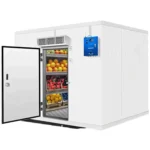
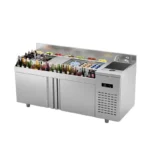
Zhongji Metal has manufactured stainless steel commercial kitchen and cold storage equipment in Shandong, China since 2010 and exports to more than 130 countries. Units are built with dressed and passivated welds in the food zone, radiused internal corners on tanks and tops, removable gaskets and adjustable legs: the stainless steel kitchen workbench range is specified this way as standard, the stainless steel separate sink is built with radiused bowl corners and a drained base, and the modular cold room is supplied with removable panels and a floor that can be cleaned without dismantling the room. Drawings show the joint details before production, so cleanability is agreed on paper rather than argued at inspection. The full range is on our Alibaba.com storefront.
Frequently asked questions
Does hygiene law specify a corner radius?
No. Regulation (EC) No 852/2004 requires surfaces that are smooth, washable, corrosion-resistant and non-toxic and that can be cleaned and, where necessary, disinfected; 21 CFR 117.40 requires seams to be smoothly bonded to minimise accumulation of food particles and dirt. A radius is the usual way to meet those outcomes in a fabricated tank or table, not a figure written into the regulation.
Is a sealed base to the floor more hygienic?
Usually less. Both regimes require the installation to allow adequate cleaning of the equipment and the surrounding area. A bead of silicone closing the gap between a plinth and the floor creates a joint that cannot be inspected or cleaned, whereas legs or castors with clearance allow the floor beneath to be mopped.
What is the difference between cleanable and sterile?
Cleanable means residue and soil can be removed to a defined, verifiable level by a normal cleaning procedure. Sterile means the absence of viable microorganisms, achieved by a sterilisation process. Kitchen equipment is designed and specified for cleanability and, where required, disinfection; the two terms are not interchangeable in a specification.
Does 21 CFR 117.40 apply to a restaurant kitchen?
Part 117 governs current good manufacturing practice and preventive controls for human food manufacturing, processing, packing and holding. Retail and food-service operations are normally inspected against a food code adopted by the local jurisdiction. The equipment principles are similar, but the citation in an inspection report will point to the adopted code rather than to Part 117.
Why does allergen cross-contact appear in equipment rules?
Because shared equipment is a recognised route for allergen transfer. 21 CFR 117.40 requires equipment and its food-contact surfaces to be maintained so as to protect food from allergen cross-contact, and requires seams to be bonded to minimise the accumulation that carries it. Cleanable geometry is the mechanical part of an allergen control programme.
What should be in the drawing package?
Joint details at internal corners, weld specification and finish, fastener locations relative to the food zone, gasket type and how it is retained, leg or castor height and floor clearance, and the service gap to walls and adjacent units. If a drawing does not show a joint, the joint will be decided on the shop floor.
Local codes vary; verify requirements with your authority having jurisdiction.
Sources
- Regulation (EC) No 852/2004 on the hygiene of foodstuffs — Annex II Chapter II surface requirements, Chapter V equipment and installation, Chapter VI waste containers, Chapter VII steam and water.
- 21 CFR 117.40 — Equipment and utensils — cleanability, corrosion resistance, non-toxic materials, smoothly bonded seams, installation for cleaning of adjacent spaces, cold compartment thermometers, instrument accuracy.
- FDA Food Code 2022 — status of the Food Code as a model offered for adoption by state, local, tribal and territorial jurisdictions; tenth edition.
Author: China Zhongji Metal
WhatsApp: +86 190 5035 2733
Website: https://zhongjimetal.com
Alibaba.com: https://zhongjimetal.en.alibaba.com