
Quick answer
A hotel kitchen spends on breadth: many cooking methods, separate preparation areas, banquet holding and dishwashing at volume. A QSR kitchen spends on speed and repetition: a narrow menu, high-capacity holding, and redundancy on the few items that must never stop. Same stainless, different allocation.
What actually differs between a hotel kitchen and a QSR kitchen?
The menu, and what happens to food after it is cooked.
A hotel kitchen serves several outlets from one back-of-house: all-day dining, room service, a lobby bar, banquets, and often a staff canteen. Each has a different service window and a different production pattern. Breakfast is a buffet with a hard start; lunch is à la carte; dinner may be a set menu for three hundred in a ballroom; room service runs until midnight with a menu that overlaps all of them. The kitchen has to hold competence across all of it simultaneously.
A QSR kitchen makes a short list of items, repeatedly, at a rate set by the till. The menu is deliberately narrow because breadth is the enemy of speed. Everything in the line exists to reduce the seconds between an order appearing on the screen and a bag reaching the counter.
That single difference — breadth versus rate — propagates through the equipment list, the utility connections and the capital plan. It is not a question of one being more sophisticated. A well-run QSR line is a precision instrument, and a hotel kitchen that tried to run at QSR speed would fail. The budgets differ because the constraints differ.
Where does capital concentrate in each model?
The table below is a qualitative map, not a cost breakdown. Percentages vary too much by market, menu and building to be useful without a specific project; what travels well is the direction of spending.
| Equipment group | Hotel kitchen | QSR kitchen | Why |
|---|---|---|---|
| Cooking range and oven capacity | High: several methods in parallel, including specialist items | Medium: few methods, sized for peak rate | Breadth versus rate |
| Holding and regeneration | High: banquet holding, plating warmers, regeneration ovens | High but narrow: holding for a handful of SKUs | Hotel holds variety, QSR holds volume |
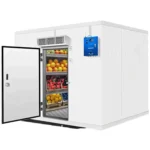
| Refrigeration | High and fragmented: many temperatures, many locations, satellite fridges at bars and floors | Medium and concentrated: a walk-in plus under-counter units on the line | Distribution across a building versus one line |
| Dishwashing | High: multiple outlets, banqueting covers, glassware | Low to medium: mostly packaging, fewer reusables | Reusable service versus disposable |
| Extraction and ventilation | High: multiple hoods, long duct runs, make-up air across zones | Medium: one or two hoods over a compact line | Footprint and cooking methods |
| Front-of-house equipment | High: buffet counters, display, carving stations, bars | Medium: display for impulse items only | Guest-facing service is the product |
| Preparation machinery | Medium: vegetable prep, butchery, pastry section | Low: prepared inputs arrive portioned | Skill in-house versus supply chain |
| Controls and monitoring | Medium: energy management across a building | High: order integration, timers, holding alarms | Speed depends on system discipline |
Read the table as a budget conversation. In a hotel, the capital is spread across many small capabilities, each with its own utility connection. In a QSR, the capital is concentrated in a few high-duty items and in the systems that keep them running.
Why does the banquet function change the utility budget?
Because a banquet does not scale the way à la carte does: it multiplies at one moment.
Fifty covers an hour apart can be cooked on the same range, one order at a time. Three hundred covers at eight o’clock cannot. The kitchen either cooks in advance and holds, or it builds capacity that sits idle the rest of the day. Most hotels do both, and both are expensive in different ways: holding equipment consumes electricity continuously, while oversizing the range consumes capital and floor space.
Three utility consequences follow, and they are the ones most often underestimated at budget stage.
Electrical peak coincidence. The banquet peak coincides with the dinner service peak and with housekeeping’s laundry load. The incoming supply has to carry the sum, not the average, which means the electrical budget is driven by a fifteen-minute window rather than by daily consumption.
Hot water and drainage. Banquet dishwashing and pot washing arrive in waves. Water heating capacity, drain size and grease management all have to be sized for the wave, and retrofitting a bigger drain after the floor is tiled is one of the most expensive corrections in a hotel project.
Extraction under part load. A hotel hood system runs at low load most of the day and at full load for two hours. Variable-speed extraction and make-up air reduce the running cost substantially, but only if the design includes the controls from the start.
A QSR faces the opposite problem: its peaks are frequent and shallow rather than rare and deep, so the design target is recovery time rather than instantaneous capacity. Our commercial kitchen hood sizing guide covers the airflow and make-up air relationship in both cases.
What does a QSR line spend on that a hotel kitchen does not?
Speed, and the redundancy that protects it.
Holding that is measured in minutes, not hours. A QSR holds a small number of items for a defined short window, then discards. The equipment must reach and hold temperature quickly, and it must be easy to clean between products. Buffet holding in a hotel is designed for a longer service with replenishment; QSR holding is designed for a countdown.
A second of everything critical. If a fryer station goes down at noon, the store stops selling. QSR operators therefore buy redundancy deliberately — a spare fryer bank, a duplicate holding unit, a second freezer — while hotel kitchens usually accept a single large item because a failure can be covered by another outlet.
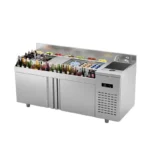
Compact, high-duty refrigeration. Under-counter refrigerated drawers and small reach-ins on the line cost more per litre than a walk-in, because they are built to be opened hundreds of times a day in a small footprint. A hotel buys a similar unit count but spreads them across floors, which changes the service model more than the specification.
Order and timing integration. Screens, timers and holding alarms are part of the production system, not accessories. This is capital that a hotel kitchen usually does not carry, because the ticket flow is managed by people rather than by a queue.
Where does the regulatory floor differ?
Less than operators expect. Both models are food businesses, and both sit under the same hygiene framework; the difference is in how much equipment the framework forces into the plan.
In the EU, Regulation (EC) No 852/2004, Annex II, Chapter II requires the design and layout of rooms where food is prepared to permit good hygiene practices, including protection against contamination between and during operations. Chapter I requires an adequate number of washbasins, suitably located and designated for cleaning hands, with hot and cold running water and materials for hygienic drying, and requires facilities for washing food to be separate from hand-washing facilities where necessary. The same Chapter requires surfaces of equipment in food areas to be sound, easy to clean and, where necessary, to disinfect, using smooth, washable, corrosion-resistant and non-toxic materials.
Those requirements scale with the number of separate processes, not with the size of the building. A hotel with pastry, butchery, banquet plating and four outlets needs a hand-wash basin and a cleanable surface at every boundary. A QSR with one line needs fewer boundaries but the same standard at each of them. In budget terms, the regulatory floor costs a hotel more because the hotel has more rooms, not because the rules are stricter.
In the United States, the FDA Food Code is a model code offered for adoption by state, local, tribal and territorial jurisdictions, and the 2022 edition is the tenth. What that means for a budget is simple and often missed: the holding temperatures, equipment clearance and hand-sink requirements that apply to your kitchen are the ones your jurisdiction adopted, sometimes with local amendments. Confirm the adopted version before the equipment schedule is frozen, because a local amendment can add an item after the drawings are complete.
How should the budget be phased?
Sequence matters more than the split, because some decisions cannot be reversed cheaply.
| Decision | When to lock it | Consequence of lateness |
|---|---|---|
| Utility capacity: electrical supply, water heating, drainage, gas | Before the equipment schedule | Retrofit cost dwarfs any equipment saving |
| Extraction and make-up air design | With the ceiling design | Duct routes become fixed by structure |
| Equipment schedule and utility matrix | Before tendering | Bids arrive on different scopes and cannot be compared |
| Refrigeration locations and door widths | Before wall and floor finishes | Trolley routes fail on site |
| Holding and regeneration strategy | Before the menu is signed off | Menu changes late, equipment is wrong |
| Spare parts and service access | At order | Unplanned downtime in the first year |
A practical rule for both models: spend the first design effort on the parts that the building fixes, and the last on the parts that a catalogue can change. Equipment can be re-specified in a week. A floor drain cannot.
Where does Zhongji Metal fit?
Zhongji Metal has manufactured stainless steel commercial kitchen and refrigeration equipment since 2010 in Shandong, China, and exports to more than 130 countries. Because the factory produces both the fabrication and the refrigeration, a project can be scheduled as one equipment package with a single utility matrix: stainless steel workbenches and separate sinks for the preparation and wash-up areas, western kitchen cooking equipment for the hot line, and modular cold rooms for bulk storage.
For hotels, the usual starting point is the wash-up and preparation layout, because those areas set the drainage and the room dimensions; our dishwashing area layout guide covers the dirty-to-clean flow. For QSR formats, the constraint is the line itself, and the equipment list is shorter but more highly specified. Models and current terms are listed on the Alibaba.com storefront.
Local codes vary; verify requirements with your authority having jurisdiction.
Frequently asked questions
Which kitchen costs more to equip, a hotel or a QSR?
Per square metre, a QSR line is usually more expensive because every item is high-duty and space is scarce. In total capital, a full-service hotel kitchen is usually higher because it carries more separate areas, more refrigeration locations and a banqueting function. The comparison only means something at project level.
Why does a hotel need more refrigeration locations?
Because service is distributed. A bar, an all-day dining outlet, a banquet floor and room service each need product within reach, and carrying it there from one central cold room costs labour and time. A QSR serves one point, so refrigeration concentrates near the line.
Is banquet equipment worth buying if it is only used twice a week?
Sometimes not. Holding and regeneration equipment that sits idle still consumes electricity and floor space. Many hotels choose to size banqueting around a flexible combination of mobile holding cabinets and a smaller permanent installation, then add capacity only when the booking pattern justifies it.
Does a QSR need a full commercial dishwashing area?
Not always. Where service is disposable, the wash-up requirement is limited to utensils, containers and hand-washing. Where the format uses reusables, the dishwashing area has to be designed at full commercial standard, and it usually becomes the space constraint.
How early should the equipment schedule be fixed?
Before tendering, and before the utility connections are finalised. The equipment schedule produces the utility matrix, and the utility matrix produces the electrical, water and drainage design. Fixing equipment after the services are installed is where most project overruns start.
Do the same hygiene rules apply to both formats?
Broadly, yes. Both are food businesses under the same hygiene framework, so the requirements for cleanable surfaces, hand-washing and separation of raw and cooked apply to both. The cost difference comes from the number of separate rooms and processes, not from a different standard.
Sources
- Regulation (EC) No 852/2004 on the hygiene of foodstuffs, Annex II
- FDA Food Code 2022
- FDA, HACCP Principles and Application Guidelines
Author: China Zhongji Metal
WhatsApp: +86 190 5035 2733
Website: https://zhongjimetal.com
Alibaba.com: https://zhongjimetal.en.alibaba.com