
Quick answer
Size an ice machine by peak-hour demand and by the bin that carries you through it, not by the 24-hour output figure alone. Production ratings are measured under stated conditions, and a warm back bar, a full bin and a busy service all reduce what the machine actually delivers. Calculate demand first, then choose output and storage together.
What drives ice demand in a foodservice operation?
Ice is consumed in four different ways, and only one of them is the drink.
| Use | What it consumes | How to count it |
|---|---|---|
| Cold drinks and cocktails | Ice in the glass, plus ice in the shaker or mixing glass | Covers per hour at peak × ice per drink |
| Bottle and display service | Ice for chilling bottled drinks and display wells | Volume of the well, plus melt rate |
| Seafood and buffet display | Ice beds for fish, shellfish and salad bars | Bed area and depth, plus melt rate |
| Kitchen and transport | Ice for blast chilling, salad crisping, transport bins | Batch size × batches per service |
The peak hour sets the machine. Average daily demand sets the bin. Sizing by daily total is the single most common mistake, because a bar that uses 120 kg across a day may use 40 kg in the busiest hour, and a machine rated at 120 kg per day cannot deliver 40 kg in one hour.
A planning method, with assumptions stated openly:
- Count covers per hour at peak, not per day.
- Apply an ice-per-drink assumption. For cold drinks, planning figures in the range of 0.2–0.4 kg per serve are commonly used; these are planning estimates, not measured values, so replace them with your own observation after two weeks of operation.
- Add display and chilling demand separately, because it is continuous rather than per-cover.
- Convert to a peak-hour figure and add a margin for waste, spillage and the customer who asks for extra ice.
A worked example: a bar serving 90 cold drinks in its busiest hour at 0.3 kg per serve needs 27 kg in that hour, plus 8 kg for bottle display, so about 35 kg. Add a 20 percent margin and the peak-hour requirement is roughly 42 kg. That number, not the daily total, is what the machine has to deliver.
How do output and storage work together?
Ice machines are rated on production over 24 hours under specified ambient and water conditions. That rating is a laboratory figure, and three things move it in a real installation.
Ambient temperature. An air-cooled machine in a hot back bar produces less ice than the rating and runs longer. The difference is significant enough that manufacturers publish separate ratings at different ambient conditions; always compare at the ambient your site will actually see.
Water temperature. Cold inlet water produces more ice per hour than warm water on the same machine. If the supply runs warm in summer, plan for the derated figure.
Bin position and use. A bin that is emptied continuously by staff refilling service wells never accumulates a buffer, so the machine has to meet instantaneous demand rather than average demand.
| Sizing check | Question to answer | Consequence if wrong |
|---|---|---|
| Peak-hour output | Can the machine deliver the busiest hour’s demand? | Running out mid-service, buying bagged ice |
| 24-hour output | Does daily production exceed daily consumption? | Gradual depletion across the week |
| Bin capacity | Does the bin cover demand between production cycles and deliveries? | Empty bin at opening or at close |
| Ambient rating | Is the rating quoted at your back-bar temperature? | Output shortfall exactly when it is needed |
| Recovery after defrost or cleaning | How long is the machine offline? | A gap that the bin must cover |
The relationship is simple arithmetic:
required 24h output = daily consumption × (1 + safety margin)
required bin        = peak-hour demand × hours the machine may be unavailable
For the example bar consuming around 120 kg a day, a 20 percent margin gives 144 kg per 24 hours. If cleaning and defrost take two hours and the machine cannot run during cleaning, the bin needs to cover the peak hour plus that gap.
Which ice type fits which use?
Ice type is a quality decision with a practical consequence: different shapes melt at different rates and suit different service formats.
| Ice type | Behaviour | Suits | Less suitable for |
|---|---|---|---|
| Full cube | Slow melting, good displacement | Soft drinks, spirits on the rocks, display | Fast-paced cocktail shaking |
| Half cube | Faster chill, moderate melt | Bars, cafés, table service | Large display beds |
| Crescent | Soft, packs well | Display beds, seafood, salad bars | Long drinks where clarity matters |
| Nugget | Chewable, high liquid content, fast chill | Smoothies, blended drinks, healthcare | Display, where it melts quickly |
| Flake | Wet, moulds to shape | Seafood display, transport, therapeutic use | Carbonated drinks |
Two operational notes. Nugget and flake machines produce ice that melts fast, so the bin empties visibly during a busy service; size the bin accordingly rather than sizing the machine harder. And display ice is a food contact surface: it must be made from potable water and handled so that it is not contaminated by scoops, glasses or hands.
What do hygiene and compliance require?
Ice is food, and it is regulated as such. In the European Union, Regulation (EC) No 852/2004 states that ice which comes into contact with food or which may contaminate food is to be made from potable water, and is to be made, handled and stored under conditions that protect it from contamination. That single sentence covers the three failure points in most bars: the water supply, the machine interior, and the way staff take ice out.
On the equipment side, NSF/ANSI 12, “Automatic Ice Making Equipment,” establishes minimum food protection and sanitation requirements for the materials, design, construction and performance of automatic ice making equipment and related components used in the manufacturing, processing, storing, dispensing, packaging and transportation of ice intended for human consumption. Specifying certified equipment is the baseline in chain procurement and shortens the plan review conversation.
The operating controls that inspection actually tests:
- Water filtration. A filter protects the machine and the product; its replacement interval belongs in the maintenance schedule, not in someone’s memory.
- Cleaning frequency. Follow the manufacturer’s interval. In practice the bin, the chute and the door gasket need more attention than the evaporator.
- Scoop discipline. A glass used as a scoop breaks, and the fragments end up in the bin. A dedicated scoop, stored outside the ice, is the whole control.
- Bin condition. Rust, standing water and a damaged lid liner are contamination routes. Stainless steel and a replaceable liner are worth specifying.
- Record keeping. Cleaning and filter changes should be logged, because an inspector will ask for the record rather than the intention.
| Compliance item | Evidence an inspector looks for |
|---|---|
| Potable water supply to the machine | Connection to a potable supply, filter change log |
| Protected storage | Lid closed, scoop stored outside the bin, no glass in the bin |
| Cleaning routine | Dated cleaning log matching the manufacturer’s interval |
| Equipment certification | Certification to the applicable NSF/ANSI standard |
| Drainage | Indirect drain, air gap, no standing water in the bin |
What should the specification include?
| Specification item | Why it matters |
|---|---|
| Cooling method (air or water cooled) | Water-cooled units reject heat to water and suit hot, enclosed back bars; air-cooled units need clearance |
| Rated output at stated ambient | Compare like with like; ask for the rating at your site’s temperature |
| Bin capacity and insulation | The buffer that covers peak hour and cleaning downtime |
| Ice type and shape | Menu and display fit, and melt behaviour in service |
| Water filter provision | Protects the evaporator and the product; confirm it is included |
| Drain and air gap | Hygiene and code compliance, plus service access |
| Legs or plinth height | Cleaning access under the unit, and hygiene inspection |
| Service access to panels | Determines whether a fault is a repair or a replacement |
| Spare parts availability locally | Ice machines fail in summer, when demand is highest |
Two of these are usually decided too late. Drain and air gap belong in the joinery drawing, not in a site visit after delivery. And local spare parts availability decides the real cost of ownership: a machine with no local service network is a machine that will be replaced rather than repaired.
Where does Zhongji Metal fit?
Zhongji Metal has manufactured commercial kitchen and refrigeration equipment in Shandong, China since 2010, and exports to more than 130 countries. Bar and beverage equipment is one of the categories we build for hotel, restaurant and distributor projects, specified together with the counter that holds it.
Three points from bar projects:
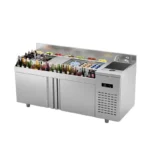
- The ice machine is designed into the bar, not added to it. Our partition ice machine range is quoted with the bin capacity and the service clearance, so the undercounter space works before the joinery is cut.
- Beverage equipment shares the same water and drain strategy. A carbonated machine and an ice machine on the same bar need one filtration plan, not two.
- The counter sets the working height. A bar counter with the ice bin at the right distance from the well is what makes a busy service possible; a bin two steps away costs more time than a faster machine saves.
Send the menu, the peak-hour covers, the back-bar temperature and the available services, and we will return a specification with the output, the bin and the water requirements stated together.
Frequently asked questions
How do I size a commercial ice machine?
Start from the busiest hour, not the daily total. Multiply peak-hour covers by an ice-per-serve assumption, add continuous display demand, then apply a safety margin. Check that the machine’s output is rated at your actual ambient temperature, and size the bin to cover the peak hour plus any cleaning or defrost downtime.
How much ice does a restaurant use per day?
There is no single figure: it depends on the menu, the climate and the service style. Measure it. Weigh the ice used across a normal week, record the busiest hour separately, and use those two numbers as the design basis. Planning assumptions are only a starting point for the first estimate.
Is 24-hour output the same as hourly capacity?
No. The 24-hour rating is total production under stated ambient and water conditions, and it cannot be drawn down in one hour. A machine rated at 120 kg per day will not deliver 40 kg in a peak hour unless its hourly capacity and bin support it, which is why peak-hour demand must be checked separately.
Which ice type is best for a bar?
Full cube for spirits and soft drinks, half cube for faster chilling in a busy service, nugget for blended drinks, flake for display and transport. The choice follows the menu and the service speed. Nugget and flake melt quickly, so they need a larger bin rather than a larger machine.
Does an ice machine need a water filter?
In practice yes. A filter protects the evaporator from scale and the ice from taste and odour problems, and it usually pays for itself in service calls avoided. Put the replacement interval in the maintenance schedule, and keep the change log with the cleaning record.
How often should a commercial ice machine be cleaned?
Follow the manufacturer’s stated interval for the machine, and clean the bin, chute and door gasket more often than the evaporator, because those are the surfaces staff and customers touch. Log every clean with a date, and check for standing water or damaged liners at the same time.
Sources
- NSF, Food Equipment Standards — scope of NSF/ANSI 12, Automatic Ice Making Equipment: nsf.org
- Regulation (EC) No 852/2004 on the hygiene of foodstuffs, Annex II — ice in contact with food to be made from potable water and protected from contamination: eur-lex.europa.eu
- US Food and Drug Administration, FDA Food Code — the model code adopted, with amendments, by state and local jurisdictions: fda.gov
- FoodSafety.gov (US Department of Health and Human Services, USDA, FDA), 4 Steps to Food Safety, reviewed 18 September 2023 — separation and clean handling of food contact items: foodsafety.gov
Local codes vary; verify requirements with your authority having jurisdiction.
Author: China Zhongji Metal
WhatsApp: +86 190 5035 2733
Website: https://zhongjimetal.com
Alibaba.com: https://zhongjimetal.en.alibaba.com