
Quick answer
A blast chiller removes heat through cold moving air and suits dense, solid or trayed food in shallow pans. A vacuum cooler removes heat by evaporating the food’s own water under low pressure, which is faster but only works on products whose surface readily gives up moisture. Choose by product, not by headline cooling speed.
What does the cooling rule actually require?
Cooling is a time-and-temperature obligation before it is an equipment choice. The FDA Food Code, section 3-501.14, sets the following for cooked time/temperature control for safety food:
| Requirement | Criterion |
|---|---|
| First stage | From 57 °C (135 °F) down to 21 °C (70 °F) within 2 hours |
| Full cycle | From 57 °C (135 °F) down to 5 °C (41 °F) or less within a total of 6 hours |
| Food from ambient ingredients | Cooled to 5 °C (41 °F) or less within 4 hours |
Two consequences follow. The first stage is the steep part of the curve, and it is where most cooling failures occur — food that misses the 2-hour checkpoint cannot recover the time later. The second is that the 6-hour total is a ceiling, not a target; a process that finishes in 6 hours has no margin for a second batch in the same cabinet.
The code also says how: section 3-501.15 allows shallow pans, smaller or thinner portions, rapid cooling equipment, stirring in an ice water bath, containers that conduct heat, and ice added as an ingredient. It then requires that containers in cooling equipment be arranged for maximum heat transfer through the walls and be loosely covered, or uncovered if protected from overhead contamination. In other words, the regulation expects the operator to help the equipment — the machine cannot fix a 200 mm deep pan stacked against the evaporator.
How does a blast chiller remove heat?
A blast chiller moves cold air across the food at high velocity inside an insulated cabinet. Heat leaves the product through its surface, so the rate is limited by the surface area exposed, the temperature difference, and the internal conductivity of the food.
That physics explains the operating rules that matter more than the model number:
Depth beats weight. A 50 mm layer of sauce cools far faster than a 150 mm layer of the same sauce at the same weight, because the heat has less distance to travel to a surface. The Food Code’s shallow-pan method exists for exactly this reason.
Airflow must reach the surface. Trays butted together, pans stacked to the ceiling of the cabinet, or lidded containers all convert a blast chiller into an insulated box. Loosely covering is permitted; sealing is not.
Dense, wet, solid foods are the hard case. A whole joint or a dense terrine has low surface area relative to its mass, so the cabinet size that handles trays of portioned food will not handle it in the same time.
The probe decides the batch. Product core temperature, not air temperature and not the display, is the measurement that proves compliance. A chiller with a probe and a printout or log is worth more than one that only shows cabinet temperature.
Blast chillers are also treated differently from holding cabinets in US energy regulation: under 10 CFR 431.62, a “holding temperature application” is defined to exclude a blast chiller or freezer, so the equipment is classed with pull-down applications rather than with holding refrigerators.
How does a vacuum cooler remove heat?
A vacuum cooler pumps air out of a sealed chamber until the pressure is low enough that water in the food boils at a low temperature. Boiling absorbs latent heat from the product, so the food cools from the inside of its own moisture rather than by conduction to cold air.
University extension guidance on the process describes the mechanism and its limits clearly. The cooling rate depends on the ratio of surface area to volume, the condition of the surface, the density of the tissue and the temperature drop required. Typical cooling times for produce run 20 to 30 minutes for a 45 °F (25 °C) drop, from 85 °F to 40 °F — fast, but not free.
The cost is water loss. The same source states that average moisture loss is 1 percent for each 10 °F of temperature drop, which for a large drop is a visible weight loss and, on leafy products, unacceptable wilting. That is why hydro-vacuum systems mist clean water onto produce before or during the cycle.
The limits are equally explicit: vacuum cooling is not suitable for many products and is limited to those whose surface readily allows evaporation. Fruits with thick skins resist moisture loss and are unsuitable, and bell peppers, eggplant and tomatoes have been known to split during vacuum cooling. Mushrooms, being porous, respond well; so do broccoli, cauliflower and cut flowers.
For a commercial kitchen, the lesson transfers directly. A vacuum cooler is a specialist tool for high-moisture, high-surface-area products, not a general replacement for a blast chiller across a menu.
Which foods suit which method?
| Product type | Blast chiller | Vacuum cooler | Note |
|---|---|---|---|
| Portioned cooked food in shallow pans | Good fit | Poor fit | Vacuum needs moisture at the surface and a chamber-compatible pack |
| Dense roasts and large joints | Workable, slower | Not suitable | Low surface area relative to mass in both cases |
| Soups, sauces, stocks | Good fit in shallow pans | Possible only with product-specific handling | Liquid in a vacuum chamber behaves differently from solid food |
| Leafy vegetables and blanched greens | Workable | Best fit | High surface-area-to-volume ratio, high moisture |
| Thick-skinned whole fruit and vegetables | Workable | Not suitable | Skin resists evaporation; some products split |
| Bakery items and part-baked bread | Workable | Product-specific | Crust and moisture content decide the outcome |
| Porous products such as mushrooms | Workable | Best fit | Porosity and low tissue density favour evaporation |
Read the table as a filter, not a ranking. For most restaurant menus, the blast chiller is the general-purpose answer and the vacuum cooler is the specialist answer for produce-driven operations.
What decides batch capacity in real service?
Capacity is where specifications mislead most often, because a nominal batch figure assumes ideal loading that service rarely delivers.
Work backwards from the requirement. Take the largest quantity of any single dish that must be cooled in one service, note the pan depth the kitchen will actually use, and convert that to the number of trays the cabinet must hold simultaneously with air still able to move between them. Then check the two-hour checkpoint against the first stage, because a cabinet that meets the 6-hour total but misses the 2-hour first stage is not compliant.
Three practical constraints usually bind before the compressor does:
- Cabinet volume versus usable volume. Trays need gaps; a cabinet rated for a number of trays at nominal spacing holds fewer once the pans are loaded the way the kitchen actually loads them.
- Batch sequencing. If the chiller must handle two services per day, the cycle time has to fit twice inside the window, not once.
- Downstream storage. Cooling is not finished at the cabinet door; the product then goes into a holding refrigerator, and the two capacities have to match or the chiller becomes a bottleneck that gets bypassed.
For a cook-chill operation, the honest way to size is to measure one real batch with a probe and a timer, then scale. Suppliers can support that with a demonstration, and the data belongs in the commissioning file.
What should you check before buying either?
| Check | Why it matters |
|---|---|
| Probe count and logging | Compliance evidence; air temperature proves nothing about the product |
| Pan depth and tray pitch accepted | Determines whether the shallow-pan method is practical |
| Cycle time at stated load, with the load defined | “Fast cooling” without a load figure is not a specification |
| Defrost and condensate handling | Wet cooling environments ice up; drainage decides reliability |
| For vacuum units: chamber size, pump capacity, cycle profile | Seals, pump and cycle logic drive both speed and maintenance |
| Water and power services at the install point | Vacuum pumps and condensers have service requirements that layout drawings often miss |
For a vacuum cooler, add one question that decides most projects: what happens to the product’s surface moisture during the cycle, and does the process need a pre-mist or post-mist stage. For a blast chiller, the equivalent question is what the cabinet does with the heat it removes — a chiller that dumps heat into a small prep room raises the ambient and slows every later batch.
Where Zhongji Metal fits
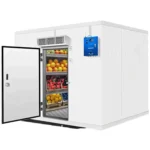
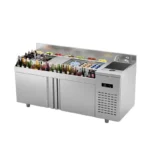
Zhongji Metal has manufactured stainless steel commercial kitchen and cold storage equipment in Shandong, China since 2010 and exports to more than 130 countries. Rapid cooling sits between the cooking line and cold storage in a project, which is why it is specified together with the modular cold room that receives the cooled product and the refrigerated workbench that holds it at the prep station. Stainless pans, trays and the trolley frames that carry them through the cooling cycle are quoted with the room, so tray pitch and pan depth are consistent from chiller to store.
For kitchens that need the cooking side specified at the same time, the western kitchen cooking equipment range covers the line upstream; the full equipment list is on our Alibaba.com storefront. CE marking is available for EU-bound orders, and electrical configuration is confirmed per order.
Frequently asked questions
Is a vacuum cooler faster than a blast chiller?
For suitable products, usually yes — extension guidance cites 20 to 30 minutes for a 45 °F drop on produce. Speed is not the deciding factor, though: the method only works where the product’s surface readily gives up moisture, and it costs water loss of roughly 1 percent per 10 °F of temperature drop.
Can a blast chiller cool liquid sauces in deep containers?
It can, but slowly, and the two-hour first stage is what fails. The Food Code’s shallow-pan method exists because heat has to travel to a surface. Split the batch across shallow pans, leave them loosely covered, and confirm with a probe rather than a timer.
Do I need a blast chiller if I already have a walk-in cooler?
If you cook and cool in batches, yes. A walk-in is designed to hold temperature, not to remove heat quickly, and loading hot food into it raises the whole room’s temperature and slows every other product. The Food Code cooling criteria apply to the cooling step, not just to final storage.
What temperature does the food have to reach, and by when?
From 57 °C (135 °F) to 21 °C (70 °F) within 2 hours, then to 5 °C (41 °F) or less within a total of 6 hours, under FDA Food Code section 3-501.14. Food prepared from ambient-temperature ingredients has a shorter window: 4 hours to 5 °C.
Why is my blast chiller slower than the specification?
Usually load geometry: pans too deep, trays butted together, containers sealed rather than loosely covered, or the cabinet packed so tightly that air cannot circulate. Ambient temperature in the room and a fouled evaporator are the next two causes. Measure one batch with a probe before concluding the machine is undersized.
Does vacuum cooling work for meat and dense foods?
Poorly. The method depends on evaporation from the product’s surface, and dense or thick-skinned products resist that loss. Extension guidance notes that thick-skinned fruits are unsuitable and that some vegetables split under vacuum. For meat and dense cooked foods, air-based blast chilling is the practical route.
Can I use either method to chill food for storage rather than for immediate service?
Yes, provided the time and temperature criteria are met and the cooled product then goes into holding equipment that maintains 5 °C (41 °F) or less. Record the probe reading at the end of the cycle; that record is what demonstrates the process worked when an inspector or auditor asks.
Local codes vary; verify requirements with your authority having jurisdiction.
Sources
- FDA Food Code 2022 — sections 3-501.14 (cooling times and temperatures) and 3-501.15 (cooling methods and container arrangement).
- NC State Extension — Vacuum Cooling — mechanism, cooling times, moisture loss and product suitability limits.
- 10 CFR 431.62 — Definitions for commercial refrigeration equipment — holding temperature application excludes blast chillers and freezers.
Author: China Zhongji Metal
WhatsApp: +86 190 5035 2733
Website: https://zhongjimetal.com
Alibaba.com: https://zhongjimetal.en.alibaba.com