
Quick answer
Choose the door by traffic and by what is carried through it. Hinged doors suit low to moderate traffic and give the best seal; sliding doors suit tight rooms and trolley traffic but need a clear track; strip curtains suit constant in-and-out movement and cannot hold temperature alone. Door energy use is regulated separately from panel insulation in the US.
What are the main walk-in cooler door types?
Four families cover almost every project, and they differ less in insulation than in operation.
Hinged doors swing on hinges and close against a frame with a gasket and, usually, a cam lift or self-closing mechanism. They seal well because the closing force is applied in one direction against a continuous gasket line. They need a clear swing arc, which is the constraint that rules them out in narrow rooms.
Sliding doors run on a top track, either surface-mounted or recessed, and move parallel to the wall. They remove the swing arc requirement, which makes them the default choice for small rooms and for trolley traffic. The trade-off is the track, the rollers and the bottom guide, all of which have to be kept clean and aligned.
Strip curtains are overlapping flexible strips hung in an opening, with no frame and no latch. They are cheap, they tolerate constant traffic and they never get left open. They also leak, because they rely on the strips falling back into place.
Air curtains discharge a plane of air across the opening. They are used where the opening must stay clear, but their performance depends on room pressure, cross-draughts and the discharge velocity matching the opening height — variables a kitchen rarely controls well.
How does a door change the energy calculation?
In the United States, walk-in doors are regulated as components in their own right, separately from the panels. Under 10 CFR 431.302, a display door is one designed for product display or with 75 percent or more of its surface area in glass or another transparent material; everything else is a non-display door. Under 10 CFR 431.304, doors are tested for energy use on their own procedure, and non-display panels are tested for R-value — which means a project can have excellent panels and a poor door, and the standards will still be met panel by panel.
The current maximum daily energy consumption figures, for equipment manufactured from 5 June 2017 under 10 CFR 431.306, are expressed per door area:
| Door class | Descriptor | Maximum energy consumption (kWh/day) |
|---|---|---|
| DD.M | Display door, medium temperature | 0.04 × Add + 0.41 |
| DD.L | Display door, low temperature | 0.15 × Add + 0.29 |
| PD.M | Passage door, medium temperature | 0.05 × And + 1.7 |
| PD.L | Passage door, low temperature | 0.14 × And + 4.8 |
| FD.M | Freight door, medium temperature | 0.04 × And + 1.9 |
| FD.L | Freight door, low temperature | 0.12 × And + 5.6 |
Add is the surface area of the display door and And the surface area of the non-display door, both truncated to the external width or height of the door leaf and its frame.
Two things follow from that table. First, low-temperature doors are allowed far more energy per square metre than medium-temperature doors, because of frosting and heater load — so a freezer door is not simply a thicker cooler door. Second, a passage door and a freight door of the same area are not interchangeable: a freight door for a low-temperature room is allowed roughly 5.6 kWh/day plus 0.12 per unit area, against 4.8 plus 0.14 for a passage door, reflecting different opening patterns and hardware.
For buyers outside the US, the numbers are not the point — the structure is. A door is a component with its own performance, and the specification should state which class it belongs to and what it was tested against, rather than describing it as “insulated”.
When is a strip curtain enough and when do you need a door?
A strip curtain is a traffic device. It reduces exchange while people walk through, but it does not close an opening, does not latch, and does not provide a controlled seal.
Use strips where the opening is in near-constant use during service, the room is medium temperature, and there is a proper door behind them for closed hours. Use a door where any of the following applies: the room holds low-temperature product, the opening is unattended for long periods, the room is the only barrier between the product and a warm, humid space, or a regulatory inspection will look for a closable opening.
The temperature requirement is the deciding factor in most food-service projects. The FDA Food Code, section 3-501.16, requires time/temperature control for safety food to be held at 5 °C (41 °F) or less. A room with a permanently open, curtain-only doorway has to recover that temperature after every passage, and recovery capacity is sized on the assumption that the door closes.
What should a sliding door include that a hinged door does not?
A sliding door has more to get wrong, so the specification has to be more explicit.
A track that can be cleaned. Overhead tracks collect grease and bind; recessed tracks protect the rollers but trap debris in the floor; surface tracks clean easily but trip. Decide which failure you prefer and write it down.
A bottom guide, not just rollers. Doors that hang only from the top swing out of plane when a trolley clips them, and the gasket then leaks along one edge.
A positive latch or closer. A sliding door has no gravity assist. Without a latch or a self-closing mechanism, it stops wherever it is left, which in a busy service is open.
A heated frame or anti-sweat control on low-temperature rooms. Freezer doors need it; without it the gasket freezes to the frame and the door is forced open, which damages the seal permanently.
A serviceable gasket. Ask for the part number and whether the profile is push-in or screw-retained. A gasket that needs the door removed will not be replaced.
A hinged door needs the same gasket discipline plus a cam lift or adjustable closer, so it seals at the bottom without the operator lifting it.
How do you size a door opening for real traffic?
Size for the largest thing that will pass through, then check the swing or slide against the room.
The trolley opening is usually the binding constraint, not the person. Measure the trolley, add clearance both sides, and confirm the door furniture does not cut the clear opening below that figure. On hinged doors the clear opening is always smaller than the leaf, and the swing arc takes floor space that also has to stay clear of racking.
Then check the sequence: door, threshold, ramp, drainage. A door opening onto a slope, or across a floor drain, gets propped open within a week. Where a trolley is used, the threshold should be flush or ramped, and the ramp must not block the swing.
Finally, check door count against traffic. One door serving receiving and prep forces constant crossing; two doors, one for raw and one for finished goods, cut both crossings and the chance of a door left open.
Which door problems show up first in service?
Door faults are predictable and nearly always present as a temperature complaint.
| Symptom | Usual cause | What to check first |
|---|---|---|
| Ice at the bottom of a freezer door | Failed frame heater, damaged gasket, or a door left ajar | Heater circuit, gasket line, latch engagement |
| Condensation and dripping on a cooler door | Warm, humid air reaching a cold surface; gasket leak or missing sweep | Gasket contact, threshold, door alignment |
| Door will not stay closed | Broken closer, worn cam, or a floor that has settled under the frame | Closer adjustment, hinge wear, threshold level |
| Sliding door binds halfway | Debris in track, worn roller, or a bent bottom guide | Track, rollers, guide alignment |
| Product near the door is warmer than the rest of the room | Air distribution, not the door — but the door is the first suspect | Evaporator airflow and stacking height before changing hardware |
| Strips hanging loose or missing | Impact damage, wrong strip weight for the opening height | Strip specification and re-hanging schedule |
The pattern in that table is worth stating plainly: most door failures are mechanical, and most are visible during a weekly walk-round. A gasket that has been torn for a month is a compressor problem in the making, because the room runs longer to hold 5 °C.
Where Zhongji Metal fits
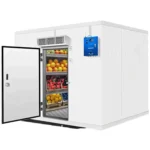
Zhongji Metal has manufactured stainless steel commercial kitchen and cold storage equipment in Shandong, China since 2010 and exports to more than 130 countries. Walk-in rooms are built as modular cold room panels with the door specified per project — hinged or sliding, medium or low temperature, with the panel thickness, door class and gasket type stated on the drawing rather than described in general terms. Rooms are quoted with the refrigeration unit matched to the panel and door load, so the recovery capacity reflects the openings the room will actually have.
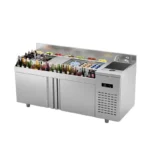
Where the cold storage is a cabinet rather than a room, the same logic applies at a smaller scale: a refrigerated workbench keeps the cold chain at the prep point and reduces how often the walk-in is opened. Glass-door display units are covered under the two-door drinks display refrigerator and the wider refrigeration range on our Alibaba.com storefront. CE marking is available for EU-bound orders; door hardware and electrical configuration are confirmed per order.
Frequently asked questions
Which door type is best for a busy commercial kitchen?
A hinged passage door for the room itself, with a strip curtain on the inside face if traffic is constant. Sliding doors suit narrow rooms and trolley traffic. Strip curtains alone are a traffic device and should not be the only closure on a room holding product at 5 °C or below.
Do walk-in cooler doors have their own energy standard?
In the United States, yes. Under 10 CFR 431.306, display doors and non-display doors have separate maximum daily energy consumption formulas by class and temperature band, and under 10 CFR 431.304 they are tested on their own procedure, separately from the panels’ R-value.
What is the difference between a passage door and a freight door?
Both are non-display doors, but they are classed separately because their opening patterns and hardware differ. For low-temperature rooms the maximum daily consumption is 0.12 × A plus 5.6 for a freight door against 0.14 × A plus 4.8 for a passage door. The class should be stated in the specification.
Can I use a strip curtain instead of a door on a cold room?
Not as the only closure. Strips reduce air exchange during traffic but do not seal, latch or provide a controlled closure, so the room has to recover temperature after every passage. Keep a door for closed hours and for unattended periods, and treat strips as additional protection.
Why does my freezer door freeze shut?
Usually a failed frame heater, a gasket that no longer seals, or a door that is not fully latched so moisture reaches the frame. Forcing it open tears the gasket and turns a heater fault into a door replacement. Check the heater circuit and the latch before applying force.
How often should door gaskets be replaced?
Replace when the gasket no longer contacts the frame along its full length, or when it is torn, hardened or compressed flat. Check monthly by closing the door on a strip of paper at several points — if the paper pulls out easily, contact is lost. Frequency depends on traffic and cleaning chemicals, not on a fixed calendar.
Does a wider door always mean more energy loss?
Not by itself. Infiltration depends on opening time, the temperature difference and air movement as much as on area, and the regulated formulas scale with door area rather than jumping per width. A wide door used twice an hour can lose less than a narrow door propped open through service.
Local codes vary; verify requirements with your authority having jurisdiction.
Sources
- 10 CFR 431.302 — Definitions concerning walk-in coolers and walk-in freezers — display door and non-display door definitions.
- 10 CFR 431.304 — Uniform test method for walk-in coolers and freezers — separate testing of doors and panels.
- 10 CFR 431.306 — Energy conservation standards for walk-in coolers and freezers — door class formulas effective from 5 June 2017.
- FDA Food Code 2022 — section 3-501.16, cold holding at 5 °C (41 °F) or less.
Author: China Zhongji Metal
WhatsApp: +86 190 5035 2733
Website: https://zhongjimetal.com
Alibaba.com: https://zhongjimetal.en.alibaba.com