
Quick answer
Two things changed for refrigeration buyers at the start of 2026, and only one of them is widely understood.
In the United States, the AIM Act Technology Transitions rule became enforceable for remote condensing units in retail food refrigeration on 1 January 2026 — 150 GWP for systems with 200 lb charge or more, 300 GWP below that. Supermarket and central rack systems follow the same thresholds on 1 January 2027.
In the EU, the F-gas Regulation (EU) 2024/573 continues its phasedown, and the Commission reported in November 2025 that HFC supply had already fallen 45% between 2015 and 2024.
What did not change: the widely circulated claim that the EPA relaxed these thresholds. The October 2025 reconsideration proposal has not been finalized, and until it is published in the Federal Register it has no legal effect.
For anyone specifying a cold room, a display case or a blast chiller today, refrigerant choice is no longer an engineering footnote. It determines whether spare parts and service gas exist in year eight of a fifteen-year asset.
What is actually in force right now
| Jurisdiction | Instrument | Status | What it means for a buyer |
|---|---|---|---|
| United States | AIM Act Technology Transitions Final Rule (Oct 2023) | In force | New remote condensing units for retail food refrigeration must meet <150 GWP (charge ≥200 lb) or <300 GWP (charge <200 lb / high-temp cascade side) from 1 Jan 2026. Supermarket racks from 1 Jan 2027 |
| United States | EPA October 2025 reconsideration proposal | Proposed only — no legal effect | Do not plan a 2026 project on the assumption thresholds will be raised. A final rule may or may not arrive |
| European Union | Regulation (EU) 2024/573 (F-gas) | In force since 11 March 2024 | Degressive HFC quota, plus equipment bans already applying to hermetically sealed commercial refrigerators above set GWP thresholds |
| Rest of world | Kigali Amendment schedules | Varies by country | Most export markets have no GWP equipment ban yet — but EU-bound goods, international hotel and retail chains, and green-building certified projects increasingly do |
The US figure worth internalising: under the AIM Act the national HFC production and consumption allowance falls to 15% of the historic baseline by 2036. That is the direction of travel regardless of any individual rulemaking.
The EU numbers are equally concrete. Between 2015 and 2024 total F-gas emissions fell by a third; HFCs are 91% of those emissions; HFC usage dropped 10% in 2024 versus 2023; and EU HFC consumption now sits 60% below its Montreal Protocol cap.
Why the refrigerant matters more than the cabinet
A commercial refrigerator is a box, a compressor and a refrigerant circuit. Buyers spend weeks comparing insulation thickness and door hinges, then accept whatever gas the factory happens to use.
That is backwards, because the gas decides three things the box cannot:
- Whether you can still service it. When a refrigerant is squeezed out of the quota system, its price rises and its availability falls. R-404A — GWP around 3,900 — is the clearest example: still in many machines, increasingly expensive to top up.
- Whether a new installation is even legal. A new remote condensing unit running R-448A or R-449A in US retail food refrigeration is no longer compliant as of January 2026.
- What it costs to run. Refrigerant choice constrains the compression ratio, the discharge temperature and therefore the efficiency you can achieve at your ambient.
Reference GWP values (AR4 basis, the basis used under the EU F-gas Regulation):
| Refrigerant | GWP (AR4) | Class | Where it still makes sense |
|---|---|---|---|
| R-744 (CO₂) | 1 | A1, high pressure | Industrial and large retail, cold climates, heat recovery |
| R-290 (propane) | 3 | A3, flammable | Integral display cases, reach-ins, small condensing units |
| R-32 | 675 | A2L, mildly flammable | Small split and condensing units |
| R-134a | 1,430 | A1 | Legacy medium-temperature, being displaced |
| R-448A / R-449A | ~1,390 | A1 | Retrofit of existing systems; not new US RCUs from 2026 |
| R-404A | ~3,900 | A1 | Legacy only — phase-out territory |
Read that table as a purchasing instrument, not a chemistry lesson. Anything above roughly 1,400 is a gas you should expect to pay more for every year you own the equipment.
The three routes, and who each one suits
There is no universally correct refrigerant in 2026. There are three viable routes and one bad habit — defaulting to whatever the last project used.
Route 1 — R-290 (propane) for integral and small systems.
Charge limits have loosened considerably: industry summaries of the updated IEC/UL 60335-2-89 standard put the allowable charge at roughly 300 g in closed appliances and up to 500 g in open cases, up from a long-standing 150 g. That is enough for display cases, reach-ins, under-counter units and small condensing units — exactly the equipment a café, bakery or convenience store buys.
Trade-off: flammable refrigerant means ventilation, ignition-source and labelling requirements, plus technicians trained for A3. In markets with immature service infrastructure, that training gap is the real risk, not the gas.
Route 2 — CO₂ (R-744) for large and industrial loads.
Transcritical CO₂ is the default answer for supermarkets and cold storage in cool climates, and works in warm climates with parallel compression or ejector designs. GWP of 1 removes the regulatory question permanently.
Trade-off: high system pressures, higher capital cost, and a service ecosystem that is still thin outside Europe and parts of Asia. Do not specify CO₂ unless you can name the contractor who will maintain it.
Route 3 — A2L synthetics as a transition.
R-32 and the A2L blends cut GWP by roughly 60–70% against R-404A while keeping familiar pressures and A1-adjacent service practice, at the cost of mild flammability handling.
Trade-off: a transition, not a destination. Expect further tightening over a fifteen-year asset life, and price the next refrigerant change into the business case.
The bad habit is buying R-404A equipment today because it is cheapest at the quotation stage. It is the one choice that guarantees a cost problem in the second half of the asset’s life.
What a compliant cold room actually looks like on paper
Refrigerant is one line of a specification. The rest of the document decides whether the room performs. These are the items that separate an export-grade cold room from a cheap one, and they are the same items a competent inspector will ask about.
| Specification item | Why it matters | What to write into the PO |
|---|---|---|
| Panel thickness and density | Drives heat load, and therefore running cost, for the next decade | Thickness in mm and core density in kg/m³, not just “PU panel” |
| Panel skin | Wet, cold, chlorinated environment — the worst case for low-grade steel | AISI 304 on food-contact and wetted faces; pre-painted steel acceptable on external faces |
| Door type and traffic | Most cold-room failures are door failures: gaskets, closers, strip curtains | Hinged vs sliding, gasket material, number of openings per hour assumed in the load calculation |
| Refrigerant and charge | Determines legality, serviceability and future gas cost | Named refrigerant, GWP, charge in kg, and whether the design requires A3/A2L handling |
| Condensing unit location | Ambient temperature drives efficiency more than any other single variable | Whether it is remote or integral, and the design ambient it is rated at |
| Defrost strategy | Wrong defrost is the number one cause of product loss complaints | Off-cycle, electric or hot-gas, with the control logic stated |
| Controls and monitoring | HACCP documentation, temperature logs, alarm escalation | Whether the controller logs, exports and alarms, and to what protocol |
| Documentation pack | Customs, insurers and auditors all ask | CE/NSF certificates, refrigerant declaration, wiring diagram, spare parts list, O&M manual |
The last row is where export projects quietly fall apart. A container of refrigeration equipment arriving without a refrigerant declaration and matching certificates can sit at customs while the opening date passes.
Regional reality: most of your buyers are not in the EU or the US
This is the part of the conversation that gets skipped, and it matters for anyone buying from a Chinese manufacturer and shipping to Africa, the Middle East, Southeast Asia or Latin America.
- No GWP equipment ban is in force in most of these markets today. R-404A and R-134a equipment still sells.
- But three pressures arrive anyway. International hotel and retail chains write EU-equivalent specifications into global tenders. Green-building certification schemes reward low-GWP systems. And refrigerant price is set globally — a shrinking HFC quota in Europe and the US raises the cost of top-up gas everywhere, including markets with no regulation at all.
- The practical consequence is that a low-GWP specification costs a modest premium now and avoids a compressor-room rebuild later. That is a business case, not an environmental argument, and it is the one that survives a CFO review.
For buyers in these regions, the sensible default in 2026 is: R-290 for small integral equipment, A2L for medium commercial, CO₂ only where a trained service partner exists. R-404A should be treated as a legacy choice, priced with its future gas cost included.
How Zhongji specifies refrigeration equipment
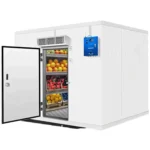
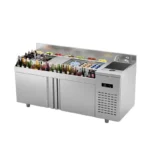
Zhongji Metal has manufactured commercial refrigeration and kitchen equipment in Shandong, China since 2010, exporting to more than 130 countries. Our cold chain range covers modular cold rooms, refrigerated workbenches and retail display cases, and every quotation states the refrigerant, the charge and the GWP rather than leaving it to the data sheet.
For projects shipping into the EU, the GCC or chain-operated sites, we quote the low-GWP configuration as standard and supply the refrigerant declaration with the certificate pack, so customs and the client’s engineering team see the same document. Where a buyer’s market has no GWP requirement yet, we still show both options side by side with the running-cost difference — the decision belongs to the buyer, but it should be made with the numbers visible.
If you are planning a cold room or a display fleet, send the room dimensions, product load and daily door openings, and we will return a load calculation plus a refrigerant recommendation — the same design-first process described in our turnkey kitchen project guide.
Frequently asked questions
Did the EPA relax the 2026 refrigerant rules?
No. The October 2025 reconsideration proposal has not been finalized and has no legal effect until it is published in the Federal Register. As of January 2026 the AIM Act Technology Transitions rule applies: new remote condensing units for retail food refrigeration must meet 150 GWP (charge ≥200 lb) or 300 GWP (charge <200 lb).
Can I still buy R-404A refrigeration equipment in 2026?
In most of Asia, Africa, the Middle East and Latin America, yes — there is no GWP equipment ban in force. In the US, new remote condensing units using high-GWP blends are no longer compliant from January 2026. Everywhere, R-404A should be priced with rising top-up gas costs over the asset’s life.
What GWP limit applies to a supermarket refrigeration system in the US?
From 1 January 2027, supermarket and central rack refrigeration systems are subject to the same 150 / 300 GWP thresholds already applying to remote condensing units from 1 January 2026.
Is propane (R-290) allowed in commercial refrigerators?
In many markets, yes. The updated IEC/UL 60335-2-89 standard raised the allowable charge well above the old 150 g limit — industry summaries put it at roughly 300 g for closed appliances and up to 500 g for open cases. Installations still require ventilation, ignition-source control, labelling and A3-trained technicians.
Does a low-GWP refrigerant cost more to run?
Not necessarily. CO₂ and R-290 can be more efficient than R-404A in the right application, but system design, ambient temperature and condenser condition dominate running cost. The reliable saving from a low-GWP refrigerant is on future gas price and compliance risk, not automatically on the electricity bill.
What documentation should ship with a cold room?
Certificates covering the electrical safety marking required in your market (CE for the EU and much of the GCC), a refrigerant declaration stating type, charge and GWP, the wiring diagram, an O&M manual, and a spare parts list. Customs and insurers ask for these more often than buyers expect.
Sources
- European Commission, Fluorinated greenhouse gases — F-gas Regulation (EU) 2024/573 and 2024 statistics (page updated 25 November 2025): climate.ec.europa.eu
- Henderson Engineers, Cut Compliance Confusion: Refrigeration Regulations in 2026 (12 January 2026) — what is in force vs proposed under the AIM Act: hendersonengineers.com
- US EPA, Phasedown of Hydrofluorocarbons — frequent questions (allowance falls to 15% of baseline by 2036): epa.gov
- IEC/UL 60335-2-89 — household and similar electrical appliances, commercial refrigerating appliances with flammable refrigerants (charge limits)
- Zhongji Metal — modular cold room and refrigerated workbench product pages
Author: China Zhongji Metal
WhatsApp: +86 190 5035 2733
Website: https://zhongjimetal.com
Alibaba.com: https://zhongjimetal.en.alibaba.com